
Category Archives: Everyday
From learning curve to full circle
Lifelong learning has become a mantra of modern existence, whether to explore passionate interests or enhance workplace skills. Once you hit the mid-career mark, however, it’s increasingly difficult to find good, useful and affordable professional development. Rare indeed are the one- or two-day sessions that actually deliver on what they’re advertising in a practical, transferable way. If not immediately applied, even the most promising models or tools quickly lose their lustre and become the latest additions to that one credenza drawer dedicated to conference swag.
Some argue that these events are more about networking anyway; if so, they should be developed and marketed with agendas better designed for mixing it up. Participants would need to know that ahead of time, of course, so they won’t be peeved that they can’t sit with their work chums and talk about what’s going on back at the office.
But changing organizational behaviour is tough. Early in my career, I had the chance to learn from a business strategist during a major re-engineering project. Through dogged prompting of other options and teasing out of risks, the naysayers were redirected by first-class change management until everyone heeded the boarding call. I admit to my own reticence when first hearing about tactics from their prestigious education, but I applied some of them in later years myself.
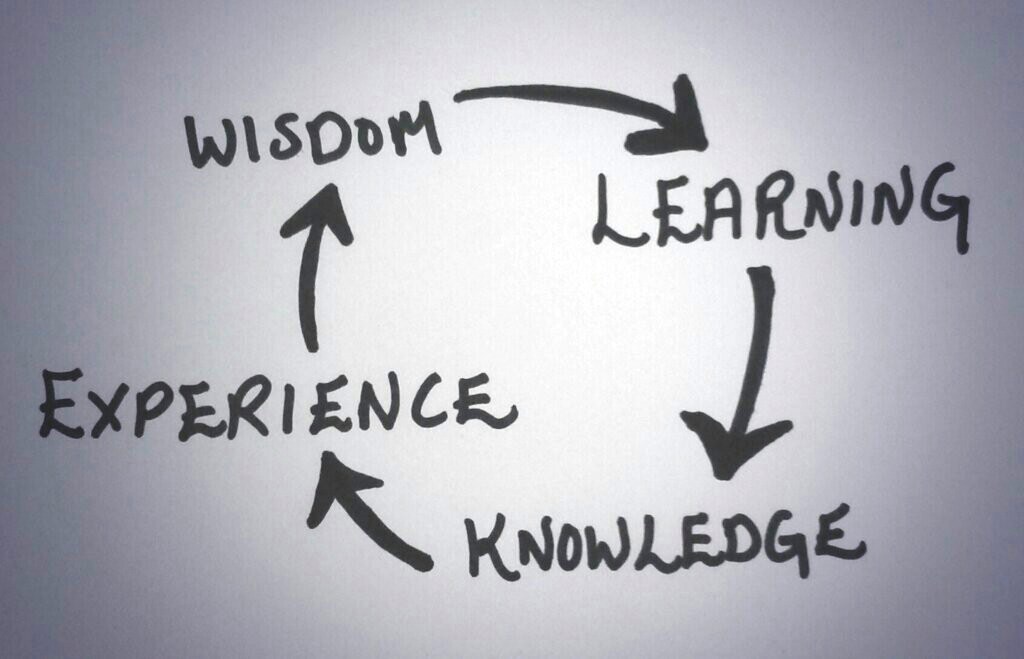
This kind of on-the-job learning, gained by observing and then doing, can be ideal. While you might not know all of the theory behind a certain technique, there is definitely an osmosis factor. Then knowledge turns to experience and wisdom through trial and error, exposure to new people, projects and environments, and zigzagging between roles and sectors.
We all hit the change-weary wall at some point though. I strongly resisted the digital-age machine until I felt the fear of falling out of step. I dove in headfirst, immediately hooked by the snappy headlines and instant gratification of new information. Nevertheless, the superfluous volume of content, along with the repetitive strain of clicking, thumb-typing, sweeping and scanning, made me long for a way to cut through the ambient noise and ambiguous discourse of digital-age mass communication and marketing.
Through a splendid stroke of serendipity, I saw the link for a certain MOOC (massive open online course). MOOCs are designed to connect interested learners with university courses offered at a variety of institutions – complete with lectures, tests and discussion forums – and free of charge other than the investment of your time and energy. You don’t earn a credit per se, but the value proposition can be high.
Critics of these programs note the tension between traditional brick-and-mortar classroom teaching and the so-called impersonal, anonymous online environment, citing issues of depth, quality and other factors both tangible and intangible, such as completion rates. But here’s the thing: MOOCs are ultimately a complement to formal in-class learning, not competition for it. There is a time and a place (and an audience) for both. Further, MOOCs are a safe way to try on a subject area without the drastic financial and life commitments that formal programs entail.
I found the materials in the MOOC I took to be highly engaging, the format readily accessible and the professors absolutely top-notch. There was also a vibrant and diverse community of students actively sharing, debating and connecting. I had to study, once I remembered how, because the quizzes and final exam very much tested whether or not you were paying attention “in class”. But I could immediately apply what I learned – some of the principles even as I was learning them – making the overall experience more beneficial than the aggregate of all of the brief professional development seminars, workshops and conferences I’ve attended over nearly two decades.
Ironically, the sponsoring institution for my course was the same school as that attended by the business strategist who wowed me early in my career. Now there’s a virtuous circle of learning if ever there was one.
Smiling at the Symphony: the TSO’s excellent “Afterworks” series
Who knew that Brahms was “tortured from the inside out” and that he wove his famously eloquent lullaby into Symphony No. 2 as a thinly veiled reminder to his lost love?
Through the wonderful storytelling of CBC’s Tom Allen, the audience at the Toronto Symphony Orchestra’s Afterworks program learned about the lives, romances, struggles and triumphs of composers Brahms and Dvorak. Music does indeed stir the soul and hearing about the poetic yearning, the joy and the melancholy, made it that much more accessible and evocative as the notes told the rest of the tale.
The Afterworks series is the perfect antidote to the mid-week blahs, starting at 6:30 p.m. (though do arrive earlier to partake of the complimentary pre-performance hors d’oeuvres). With a length of 75 minutes, it’s just the right amount of time to indulge your senses, tickle your fancy, make you wistful, and make you smile, but still leaves enough of the evening for a late dinner with the ambiance playfully set.
Speaking of playing, the TSO is brilliant as ever and the conducting by James Gaffigan at the October 23rd performance was fabulous to behold.
Loved it. Torontonians and visitors, take advantage when these are offered…I wish I could go every Wednesday!
For more information:
http://www.tso.ca/Concerts-And-Tickets/Events/2013-2014-Season/Brahms-Symphony-2-Afterworks.aspx

On things that go buzz in the night (and day)
As ninth grade drew to a close, the tenth-grade biology teacher paid my science class a visit to deliver news of a special assignment for our summer vacation. We had to collect 20 specimens – insect specimens, that is – and pin them to a board. What’s more, they had to be a variety; you couldn’t just hang up a fly strip.
I cringed upon hearing the instructions, but as an aspiring straight-A student, I was determined not to fail in this mission. To say I was just a little grossed out by the prospect would be a gross understatement!
After I designed a fashionable exhibition board with 20 multi-coloured squares of construction paper, I began my woeful hunt. Among my prey were a June bug, several other types of beetles, a few butterflies and moths, a bumble bee and a cicada.
The prescribed method of kill – and forgive me entomologists – involved putting them in a glass jar with cotton pads soaked in nail polish remover and closing the lid. Nail polish remover smells bad; add the stress of dying insects, and, well, ick. The cicada freaked me out. I’d never heard such an ungodly ruckus as when that poor thing buzzed itself into oblivion.
Then the affixing stage. This caused me no end of anxiety. I positioned the little corpses carefully into place with tweezers, but the pinning! Oh, how terrified I was that my finger or thumb would slip and I’d end up squishing the guts out of them. I didn’t want to touch the little beasties, alive or dead! (Sorry Indiana Jones, but if it had been me reaching through the mass of writhing insects to pull that lever in the Temple of Doom movie, you’d not have survived.)
The sweat ran down the sides of my face as I held my breath and hoped I was skewering the right spots and wouldn’t dismember them accidentally. The cicada was the worst and the pin slid a bit sideways. As soon as my thumb touched its scaly exterior, I leapt up and danced around the room emoting like the teenage girl I was.
Eventually this ghoulish project that was meant to teach us about sorting by phylum, etc. was done. It was almost pretty, in a way, in terms of aesthetics. The remaining great hazards included keeping the family cat from snacking on the collection and transporting it to school. Yes, I got an ‘A’.
But the bugs got their karmic revenge.
First with an invasion of cockroaches in the compartment (too small for apartment) where I lived when attending grad school, though I developed superhero-level peripheral vision that year and learned how to effectively use a caulking gun.
And then when an exotic and very large bee crawled out of the broccoli I was washing one late November night. I caught it rather deftly, thinking it might actually be a ‘killer bee’ and then I gave it a new home in a jar with holes, fed it well, and engaged the museum community in helping to identify its origin. The little stowaway even stumped the Toronto experts for a time and had to be sent to Ottawa for verification.
As it turned out, my innocuous honey bee travelled all the way from southern California to teach me a new science lesson.
 labuhrows.com