Smiling at the Symphony: the TSO’s excellent “Afterworks” series

Who knew that Brahms was “tortured from the inside out” and that he wove his famously eloquent lullaby into Symphony No. 2 as a thinly veiled reminder to his lost love?

Through the wonderful storytelling of CBC’s Tom Allen, the audience at the Toronto Symphony Orchestra’s Afterworks program learned about the lives, romances, struggles and triumphs of composers Brahms and Dvorak. Music does indeed stir the soul and hearing about the poetic yearning, the joy and the melancholy, made it that much more accessible and evocative as the notes told the rest of the tale.

The Afterworks series is the perfect antidote to the mid-week blahs, starting at 6:30 p.m. (though do arrive earlier to partake of the complimentary pre-performance hors d’oeuvres). With a length of 75 minutes, it’s just the right amount of time to indulge your senses, tickle your fancy, make you wistful, and make you smile, but still leaves enough of the evening for a late dinner with the ambiance playfully set.

Speaking of playing, the TSO is brilliant as ever and the conducting by James Gaffigan at the October 23rd performance was fabulous to behold.

Loved it. Torontonians and visitors, take advantage when these are offered…I wish I could go every Wednesday!

For more information:

http://www.tso.ca/Subscriptions/Subscription-Series/Afterworks/2013-2014-Season/Afterworks-Concert-Series.aspx

http://www.tso.ca/Concerts-And-Tickets/Events/2013-2014-Season/Brahms-Symphony-2-Afterworks.aspx

image

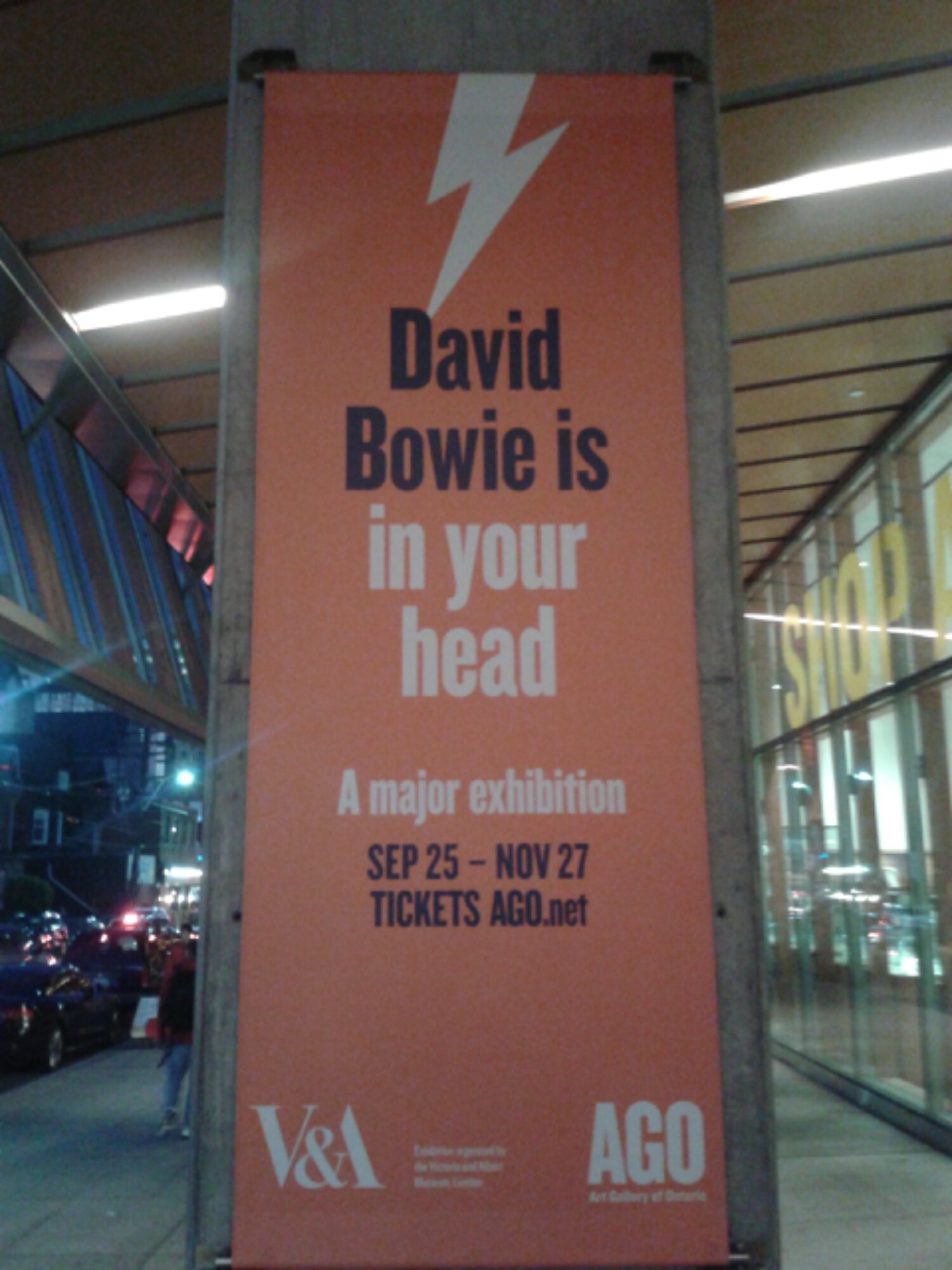
Stardusted: “David Bowie is” mesmerizing at the AGO

David Bowie. The name evokes a vast array of haunting lyrics and flamboyant styles: flash and pop, fashion and fame, glitz and glam, art and artifice, and the blurring of forms.

For me, the image that always leapt to mind was him running out on stage in the “Modern Love” video, with perfect suit, tie undone, and bouncy 80s hair bopping along as he danced at the microphone. Though I was familiar with his earlier work by osmosis if nothing else, the “Let’s Dance” album was my first Bowie purchase and – perish the thought – on cassette. I might still have it, though after 30 years, it’s now an artifact itself; a glossy memory of adolescence and the beginnings of independence. My formal introduction was thus smack-dab in the middle of an extraordinary career of transition and transformation.

The David Bowie is exhibition at the Art Gallery of Ontario (and organized by the Victoria and Albert Museum) most assuredly filled in the before-and-after gaps. This is a show about art and language, and artful language; of poetry and literature, film and photography, all of which were contributions to the multi-layered imagery inherent in song and story.

There is so very much to see – and hear, of course (do partake of the headset) – a history of pop culture and the earlier icons who influenced his work and inspired his many personae. The art in the collection is astounding, particularly his own pieces, many of which will make you pause and study.

There is an exploration of inner space and outer space, presence and existentialism, with a multitude of costumes and set designs, creations and illustrations, telling time on a complex watch with time-machine movement. On the poster for the 1986 movie “Labyrinth” in which Bowie stars as the “Goblin King Jareth” are the words, “Where everything seems possible and nothing is what it seems.”

While there are certainly illusory elements in his work, they are purposefully so, which simply reinforces the undeniable intensity of expression that has influenced pop culture over the course of four decades. Plan to stay longer than you might think, because you’ll want to linger over the details in the narrative and under the glow of the video screens. You might even find yourself wanting to sway, while colour lights up your face.

Just a few highlights:

Favourite literary reference: D.H. Lawrence, Lady Chatterley’s Lover

Favourite photograph: David Bowie, Reality Sessions by Frank W. Ockensfels 3 (2003) – it’s near the end, by the way

Favourite fashion: Costume for Screaming Lord Byron – Jazzin’ for Blue Jean by designer Alison Chitty (1984)

Favourite gift shop item: Union Jack denim (Oh, I was tempted, but alas, they didn’t have my size!!!)

image

Within these walls

I walked the ruins of Louisbourg on a cold day in August, gazing across the sweeping landscape, across what had once been streets bustling with activity, now quiet, the faint rectangles etching out the buildings of this former town, their edges barely delineating a crumbling existence.

I looked back to the reconceived structures and then to the water, where supplies took too long to arrive, the dream slowly dying when too little became too much. They held on until they were overrun; the life of Louisbourg as it once was slowly fell apart.

I don’t know if the goosebumps came from the mist streaming in off the Atlantic or the ghostly chill of the place itself, but they were there nonetheless. My visit occurred in 1999, and I still remember that sense of “feeling the history” quite vividly. 2013 marks the 300th anniversary of the founding of Louisbourg, then the capital of Île Royale (Cape Breton Island) and the celebrations at the Fortress of Louisbourg National Historic Site of Canada continue through what remains of the visitor season.

Similar experiences also await to the north and the west, at the many forts and other historic sites that dot the landscape of what was once Lower and Upper Canada. Exploring the Fortifications of Québec National Historic Site of Canada and the spectacular heritage architecture of Québec City is magical. There remains a symphony of strength here; a decadence of beauty and strategy. History is everywhere you look, and there are many mesmerizing vistas to behold. A photographer’s dream, Québec City is one of the most attractive urban centres in the country, set against the breathtaking backdrop of the St. Lawrence River.

Fort Henry National Historic Site of Canada, in Kingston, Ontario, has a vibrant interpretive program, with drilling re-enactments and plenty of stories about nineteenth century British military life. There are many cavernous tunnels to explore and dramatic views looking down to Lake Ontario. Fort Henry is the kind of site that children and adults enjoy equally. Some say it’s haunted, by the way.

Canada as a nation is relatively young compared to others, but it has a long memory and a very old soul. These are just a few examples of the places that create lasting memories as well as a new appreciation for life then and now in this great country.

For more information:

Fortress of Louisbourg National Historic Site of Canada:

http://www.pc.gc.ca/eng/lhn-nhs/ns/louisbourg/index.aspx

Fortifications of Québec National Historic Site of Canada: 

http://www.pc.gc.ca/lhn-nhs/qc/fortifications/index.aspx

Fort Henry National Historic Site of Canada:

http://www.pc.gc.ca/eng/docs/r/on/rideau/whl-lhm/chap2/chap2A2.aspx

Parks Canada:

http://www.pc.gc.ca/eng/progs/lhn-nhs/index.aspx

The dream still pristine: Sebastião Salgado’s GENESIS at the ROM

Capturing through the camera lens the pure essence of what your eyes witness of the world is an elusive goal for most of us. “You should have seen it in the real,” we say, shaking our heads. “It was so much better.”

But Sebastião Salgado brings us that real, and it is startlingly beautiful, and at times, difficult, because these are not simple stories to share or to receive, evoking a complex mixture of emotions about this narrative of life unspoiled.

His exhibition, Genesis, on display at the Royal Ontario Museum through to September 2nd, brings us sweeping landscapes and sharply focused edges. Depicted are layers upon layers of nature still untouched by human hands, as well as human hearts and minds untouched by popular culture.

Landscape and life blend together, a thin veil between them as camouflage, protecting from outside forces. Black and white mix with grey and silver, patterning in dimensions and new perspectives, disguising truth and then revealing it in a kaleidoscope of earthly design; of humanity.

Despite the razor sharpness of some elements, there remains a certain dreamlike quality, cradling the viewer in an almost otherworldly comfort, as an arm around shoulders.

For those who have all but given up on perfection, you will find it here, both in the photographs and the subjects portrayed.

It seemed fitting, somehow, that a surprise summer rain shower was just starting to wash the grit from the sea of asphalt and concrete as I left.

For more information:  http://www.rom.on.ca/en/exhibitions-galleries/exhibitions/current-exhibitions/genesis-sebastiao-salgado

Exploring the meaning of “Life”

A fascinating exploration of life through femininity is on display at Toronto’s Gardiner Museum.

Kathy Venter’s life-sized ceramic sculptures meet your gaze curve after curve, imbued with intensity, emotion and authenticity.

Stories surround in this exhibition, whispered just beneath the surface until they almost echo in the room, and inspiring thoughts of ancient fertility goddesses and everyday goddesses alike. From birth to girl to mother, the cycles intertwine.

Sitting, standing, reclining and drifting, there are philosophers, teachers, athletes, partners, mothers, daughters, sisters and friends. A few male figures are also part of the “Immersion” series, captivating through their own angles, curves and complementary beauty.

I kept expecting them to somehow move – or to say something – as I meandered through the crowd, and ultimately, they did. They spoke the art of the human form and the language of human experience, gathered from our collective community in past, present and future.

Toward the end, I found her – the one most like me, or at least my perception of myself.

Astonishing.

For more information:  http://www.gardinermuseum.on.ca/exhibition/kathy-venter-life

Dazzled at DX

A lustrous retrospective of Christian Louboutin’s remarkable designs is on display at Toronto’s Design Exchange. It is a feast for the eyes and it tickles the fancy, but it also inspires a kind of poetic contemplation of how art, architecture, form, fantasy and function all intertwine in his work.

It begins with a whimsical merry-go-round, this fête of sequins, leather, plumage, silk, wood, metal, ribbons and more. The boots are made for walking as well as for gazing, starstruck, at their soaring heights and fringed delights.

From colour-blocking to spikes to showgirl beading, glamour is everywhere. There is softness and delicacy in pinks and powder blues and the classic appeal of shiny black patent. The many sides of femininity are explored: pretty, strong, dainty, resilient and defiant, all at once, and sometimes in the same shoe.

It seems fitting that this bold exhibition is housed so close to where ideas turn to money-makers and where legends are born. In this case, however, the exchange is about craftsmanship for appreciation and appreciation over time. It is retrospective rather than speculative; the reputation solidly behind the investment.

There is a collaboration of curves, from toe to heel to leg, the shoe as extension of the human artistry it complements. Ballet to cabaret, there is a blurring of lines in the reach for beauty.

Stories abound at every turn, both real and imagined:  dreams of wearing that pair dancing and those to the opera; these with a suit and those with a great pair of jeans. It is where couture translates to real life, and where runway leads to closet.

In the midst of all the colour, shimmer, drama and flair, Cinderella is alive and well, jubilant in her pretty slippers, enveloped in magic and waiting for her moment on the red carpet. And speaking of red carpet moments, one awaits at the end.

It is impossible not to feel at least a little effervescent upon seeing this exhibition.

For more information: www.designexchange.org

A visit to Mesopotamia at the ROM

I visited the Mesopotamia exhibition at the Royal Ontario Museum today and right off the top, I will laud it as simply one of the best I’ve seen.

I went mid-day, wandering over at lunch through the muggy heat of Toronto’s recent plume of summer. The cool comfort and the interior darkness enveloped me with calm as the individual artifact exhibits guided my way.

The engagement was immediate, from the first descriptions of trading to the cuneiform tablets to the cylinder seals. Everywhere I looked were crisp and compelling chapters of the narrative, storytelling time and place, and the inherent poetry of the people whose artistry and innovation shaped not only the written word but civilization as we know it.

Around each new corner – and there are many corners, angles, mini-theatres and alcoves to discover – another detail was explained in complement to the last.

What I’d learned 20 years ago in my own undergraduate courses in Ancient Law suddenly came flooding back and my imagination lit up with animated scenes of kingdoms, codes, cities, war, justice and art.

The striding Babylonian lion stopped me dead in my tracks. Though I’d seen it before, it is simply different in this context – so dramatically new and poignant as the mesmerizing centre of one vista.

Many artifacts beckoned heart and mind as well as fingertips; even more so, of course, for being necessarily out of reach. Several tactile opportunities are on offer, however, and I took them all.

I found the final moments of the journey more solemn, but overall I felt divinely wistful.

To me, the mark of a great exhibition is one that evokes a feeling of change in the visitor – a new or enhanced perspective and a sense of being different somehow. I lingered in the philosophical buzz of quiet contemplation; the unmistakable grace of a truly affective museum experience.

If you’re in Toronto, do go.

For more information: http://www.rom.on.ca/en/mesopotamia/home